Green Energy for All: How Local Communities Can Drive the Energy Transition
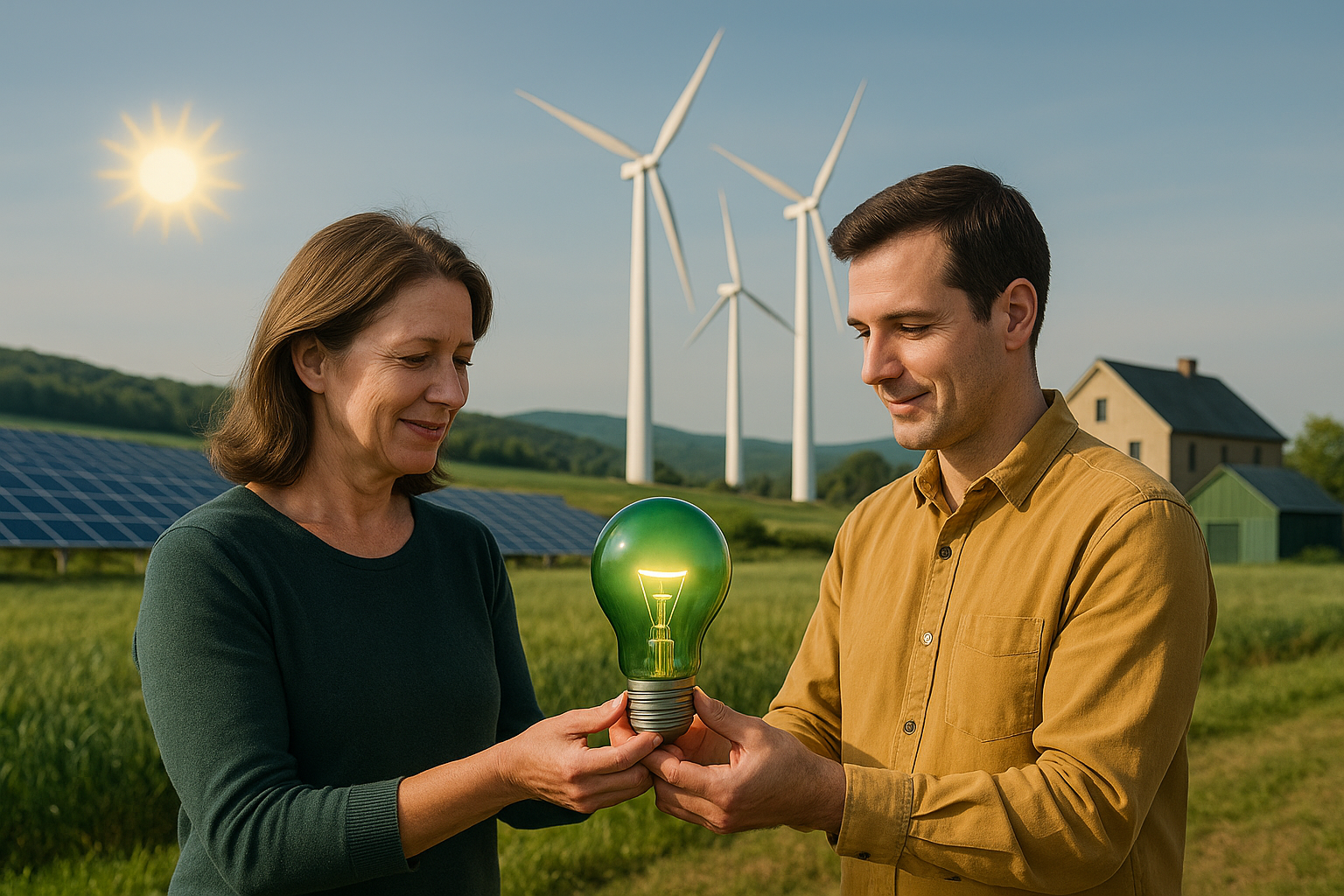
As climate change intensifies and global energy demands rise, the urgency of transitioning to renewable energy sources becomes ever more pressing. Governments and large energy providers often take center stage in this transition. However, local communities—municipalities, cooperatives, and grassroots initiatives—can play a pivotal role in driving the shift toward a more sustainable and inclusive energy future. This article explores how local-level initiatives contribute to the broader green energy transition and why empowering communities is not just beneficial but essential.
The global transition to green energy has gained momentum, particularly in the wake of the Paris Agreement and the European Green Deal. In the European Union, the Fit for 55 package and REPowerEU strategy aim to accelerate decarbonization by reducing fossil fuel dependence and scaling renewable energy sources. Romania, as an EU member, has committed to increasing the share of renewables in its energy mix from 24% in 2020 to 30.7% by 2030.
This context opens a unique window of opportunity for decentralization and local involvement. Communities are no longer passive consumers but potential ‘prosumers’—entities that both produce and consume energy. The legal frameworks now permit municipalities and citizen collectives to own, manage, and profit from renewable energy infrastructure. These developments point to a transformative shift in energy governance.
Across Europe, numerous community-led energy initiatives showcase how local actors can champion renewable energy. For instance, the German ‘Energiewende’ has seen over 1,000 energy cooperatives spring up, producing wind, solar, and biomass energy. In Denmark, local ownership of wind farms has been a norm, helping to secure public support for renewables.
In Romania, pilot projects like the energy community in Feldheim (adapted to local context), the prosumer scheme supported by AFM (Administrația Fondului pentru Mediu), and the EEA-financed projects in Harghita County provide encouraging models. These initiatives demonstrate that innovation doesn’t have to be top-down; it can emerge from villages, small towns, and regional partnerships. Technologies such as smart grids, microgrids, blockchain-based energy sharing, and IoT-enabled efficiency measures are also increasingly accessible to small-scale players.
Despite the enthusiasm, local energy transitions face several persistent challenges. First is the issue of **financing**. Access to capital for feasibility studies, installation, and maintenance of renewable energy systems is limited, especially in poorer rural municipalities. EU funds are available, but the application process is often complex and burdensome.
Second is **technical capacity**. Many communities lack the human resources—engineers, energy planners, legal experts—to conceptualize and manage energy projects. Third, **institutional inertia** and regulatory uncertainty deter experimentation. Existing grid infrastructure may be incompatible with distributed energy input, and cooperation from major utility companies is not always guaranteed.
Practical Solutions and Policy Options
To overcome these barriers, a multi-tiered support system is essential. At the national level, policies should simplify access to funding, perhaps by creating a dedicated fund for local renewable energy cooperatives with technical assistance attached. Templates, toolkits, and mentoring programs can reduce complexity.
Regionally, inter-municipal cooperation platforms can pool resources and share best practices. Partnerships between local governments, NGOs, and universities can generate innovative governance models.
European programs such as Horizon Europe and LIFE can be leveraged to test scalable models, and Romania’s National Recovery and Resilience Plan (NRRP) should prioritize community-based energy pilots. Legal recognition of energy communities, streamlined permitting, and feed-in tariffs will further incentivize local initiatives.
Romania’s rural and peri-urban areas, especially in Transylvania, Moldova, and the South Muntenia region, are rich in biomass, solar, and small-scale hydro potential. The shift to green energy can bring significant co-benefits: reduced energy poverty, local job creation, skills development, and strengthened social cohesion.
For example, a small commune investing in solar panels for public buildings can reduce its electricity bills, reallocate savings to social services, and inspire residents to adopt similar practices. Municipal associations such as AMR and ACoR could play a central role in advocating and guiding local authorities through this process.
Green energy is no longer the domain of national ministries and multinational corporations alone. Local communities have the agency, motivation, and—if supported properly—the means to lead meaningful energy transitions. Their proximity to people’s real needs and their ability to foster trust and participation are invaluable assets in a sector often dominated by technical and financial complexity.
As Romania aligns itself with EU climate targets, empowering municipalities, villages, and citizen cooperatives is not just a desirable path—it is a strategic imperative. Green energy for all is not a slogan, but a policy direction that begins with the grassroots.
Sources:
- European Green Deal
https://ec.europa.eu/info/strategy/priorities-2019-2024/european-green-deal_en - REPowerEU Plan
https://energy.ec.europa.eu/topics/energy-strategy/repowereu_en - Fit for 55 Package
https://climate.ec.europa.eu/eu-action/fit-55_en - Directive (EU) 2018/2001 on the promotion of the use of energy from renewable sources (RED II)
https://eur-lex.europa.eu/legal-content/EN/TXT/?uri=CELEX%3A32018L2001 - Planul Național Integrat în domeniul Energiei și Schimbărilor Climatice (PNIESC) – România
https://energie.gov.ro/pniesc/ - AFM – Programe pentru prosumatori
https://www.afm.ro/prosumatori.php - Planul Național de Redresare și Reziliență (PNRR) – Componenta Energie
https://mfe.gov.ro/pnrr/ - Community Energy in Germany – DGRV Report
https://www.dgrv.de/en/publications/community-energy-in-germany/ - European Federation of Renewable Energy Cooperatives (REScoop.eu)
https://www.rescoop.eu/ - Danish Community Wind Ownership Model
https://energypedia.info/wiki/Denmark_Energy_Situation - Proiecte finanțate prin EEA Grants în România – energie regenerabilă
https://www.eeagrants.ro/